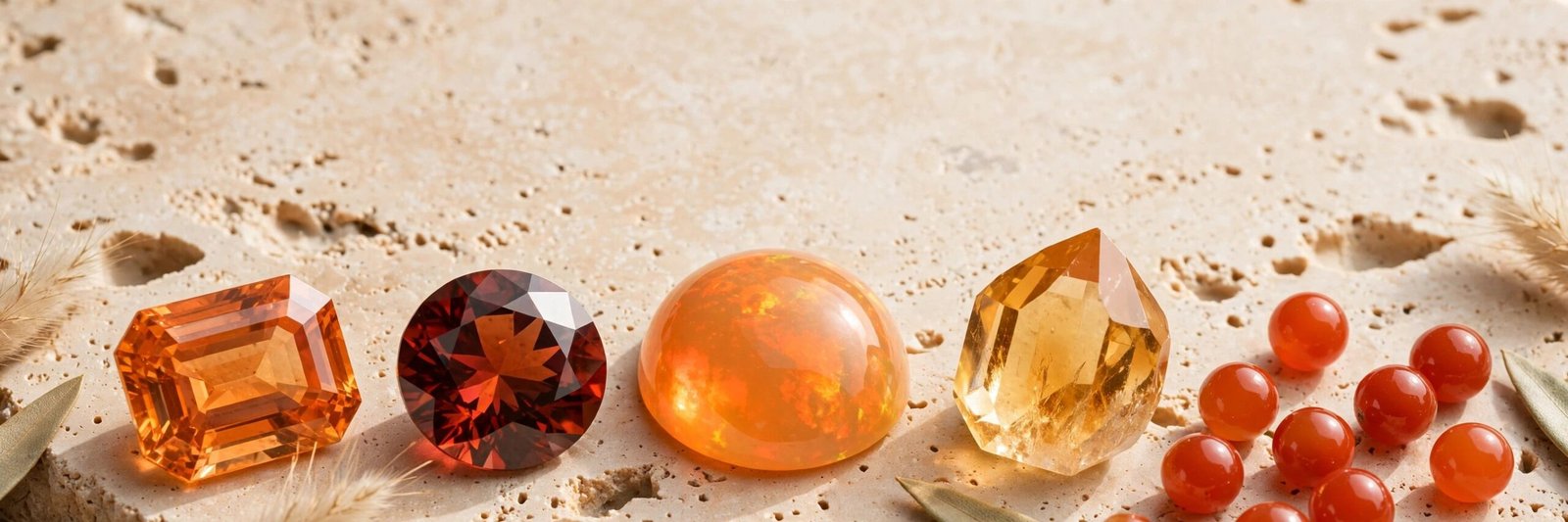
Orange Gemstones: 20 Types, Comparison, Prices & How to Choose the Right One
Orange Gemstones: Types, Meaning, Prices, and How to Choose the Right One
Quick Answer: Orange gemstones are gem materials that occur in orange shades — from pale apricot and peach to vivid mandarin, red-orange, and honey brown. They are not one mineral family. The best-known orange gemstones are orange sapphire, spessartine (mandarin) garnet, fire opal, citrine, and carnelian. For everyday rings, orange sapphire is the most durable choice (Mohs 9). For affordable jewelry, citrine and carnelian are the most practical. Always check hardness, treatment, and the type of jewelry before you buy.
What Are Orange Gemstones?
Orange gemstones are gems defined by color, not by chemistry. An orange sapphire is corundum, carnelian is chalcedony (quartz), sunstone is feldspar, and amber is fossilized tree resin. Two stones can look almost the same color and still be completely different materials with different hardness, value, and care needs.
That is why color alone should never decide a purchase. Before choosing an orange stone, check three things:
- Hardness — resistance to scratching, measured on the Mohs scale from 1 (softest) to 10 (diamond).
- Toughness and stability — how the stone handles impact, heat, light, and chemicals. A stone can be hard and still chip if it has cleavage (a natural splitting direction), which is true of topaz and moonstone.
- Treatment — whether the color is natural, heated, dyed, coated, or created in a lab. Treatment is common and accepted for many stones, but it must be disclosed and it affects price.
Why Are Some Gemstones Orange?
Orange color in gemstones is usually caused by trace elements or defects inside the crystal. Iron contributes to the warm tones of citrine and hessonite garnet, manganese produces the pure mandarin orange of spessartine garnet, and iron combined with chromium colors orange sapphire. In tangerine quartz, the orange sits on the surface as an iron-oxide coating. The cause of color matters because it affects stability — a surface coating can scratch off, while color caused inside the crystal does not.
Orange Gemstones Comparison Chart
Use this chart for a fast comparison. Price level is relative ($ = most affordable, $$$$ = most expensive) and varies with size, color saturation, clarity, origin, and treatment status.
| # | Gemstone | Typical Orange Shade | Family / Material | Transparency | Mohs Hardness | Common Treatment | Price Level | Best Jewelry Use |
|---|---|---|---|---|---|---|---|---|
| 1 | Orange Sapphire | Peach to vivid orange | Corundum | Transparent–translucent | 9 | Heat; sometimes beryllium diffusion | $$$$ | Rings, all fine jewelry |
| 2 | Spessartine Garnet | Mandarin to red-orange | Garnet group | Transparent–translucent | 6.5–7.5 | Usually untreated | $$$ | Rings, earrings, pendants |
| 3 | Hessonite Garnet | Honey to cinnamon brown | Grossular garnet | Transparent–translucent | 6.5–7.5 | Usually untreated | $$ | Pendants, earrings, protected rings |
| 4 | Fire Opal | Yellow-orange to red-orange | Hydrated silica (opal) | Transparent–translucent | 5.5–6.5 | Occasionally stabilized/impregnated | $$–$$$ | Earrings, pendants, protected rings |
| 5 | Orange Diamond | Yellow-orange to pure orange | Diamond (carbon) | Transparent | 10 | Lab-grown and color-treated stones exist | $$$$ | All fine jewelry |
| 6 | Imperial Topaz | Golden to pink-orange | Topaz | Transparent | 8 | Trade-name limits; some heat/coating in the market | $$$–$$$$ | Rings (protected), pendants, earrings |
| 7 | Orange Zircon | Honey to reddish orange | Zircon | Transparent | 6–7.5 | Usually heat-treated | $$ | Earrings, pendants, occasional rings |
| 8 | Orange Tourmaline | Peach to brownish orange | Tourmaline group | Transparent–translucent | 7–7.5 | Heat or irradiation possible | $$ | Rings, earrings, pendants |
| 9 | Orange Spinel | Peach to vivid orange | Spinel (magnesium aluminum oxide) | Transparent | 8 | Usually untreated | $$–$$$ | Rings, earrings, pendants |
| 10 | Citrine | Yellow-orange to reddish orange | Quartz | Transparent | 7 | Most market stock is heat-treated amethyst | $ | Rings, earrings, pendants, bracelets |
| 11 | Carnelian | Orange-red to brown-orange | Chalcedony (quartz) | Translucent–opaque | 6.5–7 | Heat or dye common | $ | Bracelets, beads, rings, pendants |
| 12 | Sunstone | Peach, copper, orange | Feldspar | Transparent–opaque | 6–6.5 | Imitations in aventurine glass exist | $–$$ | Beads, earrings, pendants |
| 13 | Peach Moonstone | Pale peach to apricot | Feldspar | Translucent–opaque | 6–6.5 | Glass imitations exist | $ | Beads, pendants, earrings |
| 14 | Orange Agate | Orange, rust, banded red-orange | Chalcedony (quartz) | Translucent–opaque | 6.5–7 | Dye and heat common | $ | Bracelets, pendants, rings |
| 15 | Orange Jasper | Burnt orange to earthy brown | Opaque quartz material | Opaque | 6.5–7 | Dye/stabilization possible; many trade names | $ | Bracelets, pendants, cabochons |
| 16 | Amber | Honey to deep orange-brown | Fossilized resin (organic) | Transparent–opaque | 2–2.5 | Heat, reconstitution; copal/plastic imitations | $–$$ | Earrings, pendants, light bead strands |
| 17 | Orange Coral | Peach to red-orange | Calcium carbonate (organic) | Translucent–opaque | 3–4 | Dye, bleaching, impregnation common | $$ | Earrings, pendants, beads (occasional wear) |
| 18 | Orange Calcite | Bright pure orange, often with white | Calcite (calcium carbonate) | Translucent–opaque | 3 | Wax/resin surface treatment possible | $ | Cabochons, carvings, occasional pendants |
| 19 | Sardonyx | Banded orange-brown with white/cream | Chalcedony (quartz) | Translucent–opaque | 6.5–7 | Dye common in banded material | $ | Beads, cameos, rings, bracelets |
| 20 | Tangerine Quartz | Orange surface color on quartz points | Quartz with iron-oxide coating | Transparent–translucent | 7 (coating is surface-thin) | Natural coating; color is on the surface | $ | Pendants, wire-wrapped points, collector pieces |
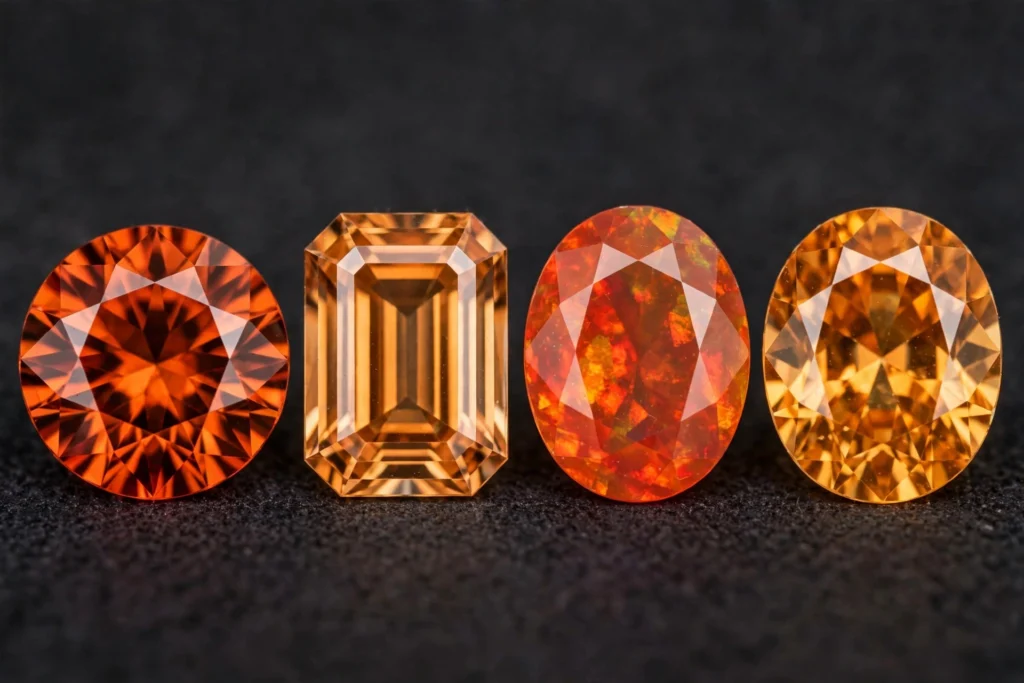
20 Orange Gemstones Explained
Each stone below follows the same format — shade, hardness, origin, treatment, price, and best use — so you can compare them quickly and fairly.
1. Orange Sapphire
At a glance: Corundum · Mohs 9 · Transparent · Price: high
Orange sapphire is the most practical precious orange gemstone for daily wear. Its color runs from soft peach to vivid tangerine and deep burnt orange, caused by iron and chromium inside corundum — the same mineral family as ruby and blue sapphire. Important sources include Sri Lanka, Madagascar, Tanzania, and Australia. Most orange sapphire is heat-treated, and some material is beryllium-diffused, a treatment that can strongly affect value and is only detectable with laboratory testing. For any expensive stone, ask for an independent gemological report. Best use: engagement rings and any fine jewelry worn every day.
2. Spessartine Garnet (Mandarin Garnet)
At a glance: Garnet group · Mohs 6.5–7.5 · Transparent to translucent · Price: moderate to high
Spessartine is the reference stone for pure mandarin orange. Its color comes from manganese, and the finest “mandarin garnet” — first made famous by finds in Namibia — shows a saturated, almost neon orange with excellent brilliance. Other sources include Nigeria, Mozambique, and Sri Lanka. Spessartine is usually untreated, which collectors value. Expect inclusions: fine, wavy internal features are normal for this garnet, and a perfectly clean stone over 2–3 carats is uncommon and priced accordingly. It has no cleavage, so it wears better than its hardness alone suggests. Best use: rings in protective settings, earrings, and pendants.
3. Hessonite Garnet
At a glance: Grossular garnet · Mohs 6.5–7.5 · Transparent to translucent · Price: affordable to moderate
Hessonite is spessartine’s warmer, earthier cousin — honey, cinnamon, and brown-orange instead of vivid mandarin. It is famous for its “whisky-and-water” or swirled internal appearance, which helps gemologists identify it. Main sources include Sri Lanka, India, and Brazil. Hessonite is usually untreated. It suits buyers who want a natural, untreated orange garnet at a lower price than mandarin material, and its warm tone pairs especially well with yellow gold. Best use: pendants and earrings; rings in protected settings.
4. Fire Opal
At a glance: Hydrated silica · Mohs 5.5–6.5 · Transparent to translucent · Price: moderate (fine red-orange is high)
Fire opal is valued for its body color — yellow-orange, orange, or red-orange — rather than the rainbow play-of-color seen in white or black opal, although some fire opal shows both. Mexico is the classic source, with additional material from Brazil, Ethiopia, and Australia. Fire opal is relatively soft and can be sensitive to heat, drying, and impact, so it belongs in earrings, pendants, and rings with protective settings rather than in a ring worn daily without care. Some material is stabilized or impregnated; ask before buying. Best use: pendants and earrings where its saturated color is the centerpiece.
5. Orange Diamond
At a glance: Diamond · Mohs 10 · Transparent · Price: highest of all orange gems
A natural diamond with a pure, strongly saturated orange color is among the rarest of all fancy-color diamonds — and the most valuable orange gemstone in this guide. Most orange diamonds show yellow or brown modifiers; a pure “pumpkin” orange with documented natural color origin commands exceptional prices. Because laboratory-grown diamonds and color-treated natural diamonds also exist in orange shades, origin-of-color documentation from a major laboratory is essential at this price level. Best use: high jewelry and collector pieces; durability is excellent, although diamond can still chip on a hard blow along its cleavage.
6. Imperial Topaz
At a glance: Topaz · Mohs 8 · Transparent · Price: high for true imperial material
Imperial topaz is the prized golden-orange to pink-orange topaz classically associated with Ouro Preto, Brazil. It is hard (Mohs 8) but has perfect cleavage, so a sharp knock can split it — hardness is not the same as toughness. The name “imperial” is a trade term, not a laboratory grade, and it is sometimes applied loosely to ordinary golden topaz, so buy on the actual color and a report, not the label alone. Best use: pendants, earrings, and rings in bezel or otherwise protective settings.
7. Orange Zircon
At a glance: Zircon · Mohs 6–7.5 · Transparent · Price: moderate
Orange zircon offers some of the strongest brilliance and fire of any orange gem, often looking brighter than stones that cost more. Colors run from honey to reddish orange. Most orange zircon is heat-treated from brownish rough — a stable, accepted treatment that should still be disclosed. Note that zircon is a natural mineral and has nothing to do with cubic zirconia, the synthetic diamond imitation it is often confused with. Its facet edges can abrade over time, so it suits earrings, pendants, and occasional-wear rings best.
8. Orange Tourmaline
At a glance: Tourmaline group · Mohs 7–7.5 · Transparent to translucent · Price: moderate
Orange tourmaline covers peach, golden-orange, and brownish-orange shades, and individual stones can shift slightly in appearance between daylight and warm indoor light. Sources include Brazil, Nigeria, Mozambique, and Afghanistan. Tourmaline is reasonably durable for jewelry, but heavily included stones should not be cleaned ultrasonically, and heat or irradiation treatment is possible, so disclosure matters. Because clean, vivid orange tourmaline is less common than pink or green material, it is a good choice for buyers who want something slightly unusual. Best use: rings, earrings, and pendants.
9. Orange Spinel
At a glance: Spinel · Mohs 8 · Transparent · Price: moderate to high
Orange spinel is one of the most underrated orange gemstones. Spinel is magnesium aluminum oxide, is singly refractive (so its color looks pure and consistent), has a hardness of 8 with no cleavage, and — importantly — the vast majority of fine natural spinel is completely untreated. Colors range from peach and pastel orange to vivid tangerine, with sources including Myanmar, Vietnam, Tanzania, and Sri Lanka. For buyers who want a durable, natural-color alternative to orange sapphire at a lower price, orange spinel is often the smartest recommendation in this list. Best use: rings, including engagement rings, earrings, and pendants.
10. Citrine
At a glance: Quartz · Mohs 7 · Transparent · Price: most affordable transparent orange gem
Citrine is the transparent quartz variety that ranges from pale yellow through golden orange to the deep reddish-orange shade sold as Madeira citrine. Natural citrine is uncommon; most citrine on the market is amethyst that has been heat-treated, a permanent and widely accepted treatment that should be disclosed. Brazil is the main source. At Mohs 7 with good toughness and large available sizes at low prices, citrine is the easiest way to get a big, clean, orange faceted stone on a budget. Best use: all jewelry types, including large statement rings and earrings.
11. Carnelian
At a glance: Chalcedony (quartz) · Mohs 6.5–7 · Translucent · Price: affordable
Carnelian is the most famous orange gemstone in the bead and cabochon world — and one of the most common orange gems overall. This translucent chalcedony ranges from soft orange through red-orange to reddish brown, with the most valued material showing a rich, even red-orange glow. Sources include India, Brazil, Uruguay, and Egypt (historically). Heat and dye treatments are common and accepted in this price range, but should be disclosed. Carnelian has been used in seals, amulets, and jewelry for thousands of years, and its combination of durability, availability, and price makes it the default choice for orange bead bracelets. Best use: bracelets, beads, pendants, and rings.
12. Sunstone
At a glance: Feldspar · Mohs 6–6.5 · Transparent to opaque · Price: affordable to moderate
Sunstone is a feldspar that can show a coppery metallic shimmer (schiller) caused by tiny copper or hematite inclusions, most famously in material from Oregon, USA; India is another major source. Colors include peach, copper, and warm orange. Sunstone has cleavage and can chip on a hard edge, so it is safer in earrings, pendants, and beads than in an exposed ring. Beware imitations made of aventurine glass (“goldstone”), which is man-made and sparkles more uniformly. Best use: beads, earrings, and pendants.
13. Peach Moonstone
At a glance: Feldspar · Mohs 6–6.5 · Translucent · Price: affordable
Peach moonstone is the soft end of the orange palette — pale peach and apricot with moonstone’s characteristic floating sheen (adularescence). It is a feldspar, mainly sourced from India and Madagascar, and it is cut almost exclusively as cabochons and beads to show the sheen. Like sunstone, it has cleavage, scratches more easily than quartz, and should be kept away from hard knocks. Glass imitations and vague trade names are common, so buy from sellers who name the material clearly. Best use: pendants, earrings, and beads for a soft, warm look.
14. Orange Agate
At a glance: Chalcedony (quartz) · Mohs 6.5–7 · Translucent to opaque · Price: affordable
Agate is banded chalcedony, and orange agate shows those layers in orange, rust, cream, and red-orange. It is tough, widely available in large sizes, and takes a good polish, which makes it a staple for bracelets, pendants, and carved pieces. Dyeing is very common in agate — much bright orange agate has been color-enhanced — and dye stability can vary, so ask the seller directly and avoid assuming a vivid color is natural. Best use: bracelets and pendants where pattern matters more than transparency.
15. Orange Jasper
At a glance: Opaque quartz material · Mohs 6.5–7 · Opaque · Price: affordable
Jasper is the opaque member of the quartz family, and orange jasper covers burnt orange, rust, and earthy brown, often with clouds, veins, or landscape-like patterns. Because it is opaque, jasper is chosen for pattern rather than sparkle, and no two beads look identical. Material comes from many countries, including India, Madagascar, and the USA. Dyeing, stabilization, and invented trade names all occur, so the buying question is simple: what is the material, and what has been done to it? Best use: bead bracelets, pendants, and cabochons.
16. Amber
At a glance: Fossilized tree resin (organic) · Mohs 2–2.5 · Transparent to opaque · Price: affordable to moderate
Amber is not a mineral at all — it is tree resin fossilized over millions of years, most famously from the Baltic region, with other sources including the Dominican Republic and Myanmar. Its honey to deep orange-brown colors, warmth to the touch, and very light weight make large pieces comfortable to wear. Amber is also one of the softest materials in this guide, so it scratches easily and must be kept away from heat, perfume, hairspray, and solvents. Copal (younger resin), reconstituted amber, and plastic imitations are common, so buy amber from sellers who test and describe it honestly. Best use: earrings, pendants, and light bead strands for occasional wear.
17. Orange Coral
At a glance: Organic calcium carbonate · Mohs 3–4 · Translucent to opaque · Price: moderate
Precious coral is a biological skeleton material, not a mineral, and its natural colors run from pale peach (“angel skin”) through salmon to deep red-orange. It is soft, porous, and damaged by acids — including perfume and even skin oils over time — so it is strictly an occasional-wear material that should be wiped with a soft cloth after use and stored separately. Dyeing, bleaching, and plastic imitation are widespread. Coral harvesting is also regulated in many places for environmental reasons, so ask about origin and legality, and consider vintage or recycled coral. Best use: earrings, pendants, and beads worn occasionally.
18. Orange Calcite
At a glance: Calcite · Mohs 3 · Translucent to opaque · Price: very affordable
Orange calcite shows a bright, cheerful, almost juicy orange, often with white or clear zones, and a waxy-to-glassy luster. Mexico is the best-known source. At Mohs 3 it is genuinely soft — it can be scratched by a copper coin and damaged by household acids — so despite its low price and attractive color, it is a poor choice for rings or daily bracelets. It is most often sold as cabochons, carvings, spheres, and tumbled stones, sometimes with a wax or resin surface treatment. Best use: pendants worn occasionally, carvings, and collector/display pieces.
19. Sardonyx
At a glance: Banded chalcedony (quartz) · Mohs 6.5–7 · Translucent to opaque · Price: affordable
Sardonyx is chalcedony with straight, parallel bands that alternate between sard — the orange-brown, carnelian-like layer — and onyx layers in white, cream, or brown. That crisp banding made it a classic material for cameos, intaglios, and signet rings for centuries, because a carving can sit in one color layer over another. India and Brazil are traditional sources. Sardonyx is durable enough for everyday jewelry, and it is also listed as an August birthstone alongside peridot and spinel. Dyeing is common in banded material and should be disclosed. Best use: cameos, beads, rings, and bracelets.
20. Tangerine Quartz
At a glance: Quartz with an iron-oxide surface coating · Mohs 7 (quartz) · Transparent to translucent · Price: affordable
Tangerine quartz is quartz crystal whose orange color comes from an iron-oxide (hematite-rich) coating on the surface of the crystal, rather than from inside it. It is most often sold as natural points and clusters from Brazil and Madagascar, and in jewelry it appears as wire-wrapped or drilled pendants. The key buying fact is that the color layer is surface-thin: it can scratch or wear at contact points even though the quartz underneath is hard. Handle it as a feature piece, not a daily-wear ring stone. Best use: pendants and collector pieces.
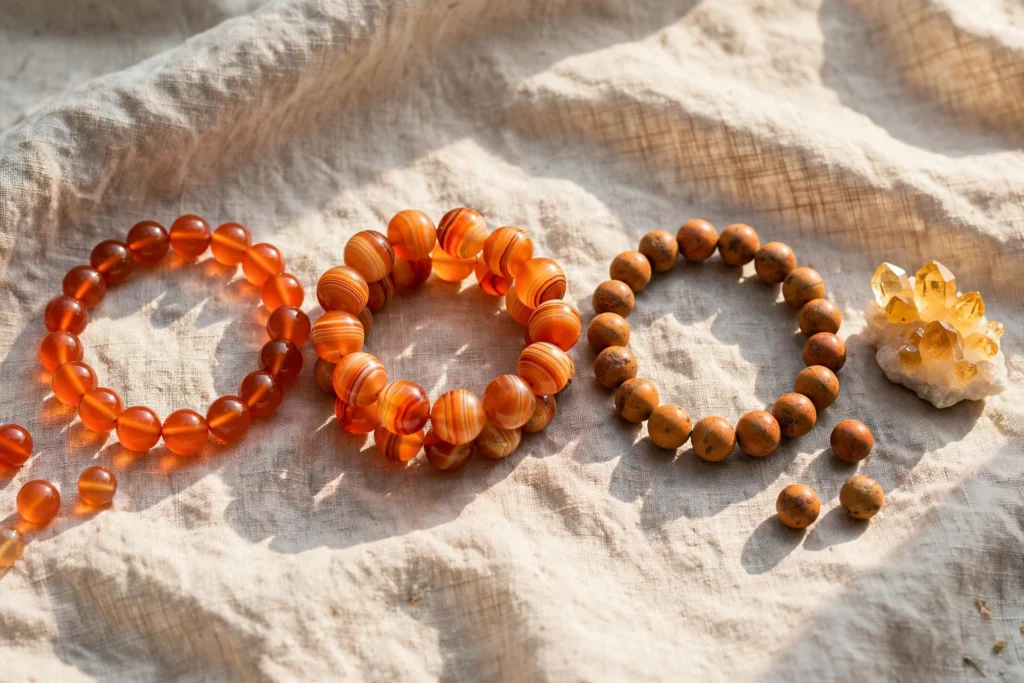
Orange Gemstones by Shade
Choosing by shade is often easier than choosing by name. Find the color you want first, then pick the most durable stone that produces it within your budget.
Pale Peach and Apricot
Peach moonstone, pale sunstone, peach tourmaline, peach spinel, and pale orange sapphire sit at the quiet end of the palette. Moonstone looks soft and diffuse, faceted spinel and sapphire look crisp and bright. This range suits subtle jewelry and pairs well with rose gold.
Bright and Vivid Orange
Spessartine (mandarin) garnet is the reference point for vivid orange. Fire opal, vivid orange sapphire, orange spinel, and rare orange diamond can reach similar saturation. Strong color should always trigger a treatment question — ask what was done to the stone before assuming the color is natural and paying a premium for it.
Red-Orange
Carnelian, fire opal, spessartine garnet, hessonite in its redder material, and some sapphire and topaz lean toward red. Red-orange stones look richer in yellow gold and warmer against brown cord and leather; white metals sharpen their contrast.
Honey, Brown, and Earthy Orange
Hessonite garnet, orange jasper, orange agate, amber, dark Madeira citrine, and some sunstone cover rust, honey, cinnamon, and burnt orange. These are the easiest shades to wear casually and combine well with denim, olive, tan, navy, charcoal, and cream.
Orange Gemstone Meaning, Symbolism & Birthstones
In crystal and jewelry tradition, orange gemstones are associated with creativity, confidence, enthusiasm, warmth, and motivation. Orange is linked in chakra tradition to the sacral chakra (the energy center associated with creativity and emotion). Carnelian in particular has a long history as a stone of courage and action, and citrine is traditionally nicknamed the “merchant’s stone” in folklore about prosperity.
These associations are cultural beliefs and traditions, not scientific or medical facts — no gemstone has been proven to heal, change energy, or affect health. Buy an orange gemstone because you love its color, story, and craftsmanship, and treat the symbolism as a meaningful bonus.
Orange Birthstones
- November: Topaz and citrine are November’s two birthstones. Imperial (orange) topaz is the traditional warm-toned November stone, and golden-to-orange citrine is its affordable counterpart — both deliver November’s signature golden-orange color at very different prices.
- August: Sardonyx is a traditional August birthstone, sharing the month with peridot and spinel — so orange sardonyx and peach-to-orange spinel are also birthstone choices.
- Leo and Sagittarius (traditional zodiac associations): Carnelian, citrine, and fire opal are traditionally linked with fire signs in zodiac lists, which is why they are popular birthday gifts for Leo and Sagittarius. Zodiac lists vary by source; treat them as tradition, not a fixed rule.
Rarest, Most Valuable & Most Common Orange Gemstones
What is the rarest orange gemstone? A natural diamond with a pure, unmodified orange hue is among the rarest orange gemstones in the world. Fine padparadscha sapphire, vivid untreated orange sapphire, and top-quality imperial topaz are also exceptionally scarce.
Which orange gemstone is the most valuable? Fine natural fancy-orange diamond generally sits at the top, especially with pure, strongly saturated color and documented natural origin of color. Below it, the practical value ranking for fine material is broadly:
- Natural fancy orange diamond
- Padparadscha and fine vivid orange sapphire
- Fine mandarin (spessartine) garnet
- True imperial topaz
- Fine fire opal with strong red-orange color
- Orange spinel and orange zircon
- Citrine — the most affordable transparent option by a wide margin
Individual prices vary widely with size, saturation, clarity, origin, and treatment. The gemstone name alone never establishes a price — an exceptional example of a “cheaper” stone can cost more than a poor example of a “precious” one.
What is the most common orange gemstone? Carnelian. It is abundant, inexpensive, durable, and has been used in jewelry longer than almost any other orange gem. Citrine is the most common transparent faceted orange gemstone.
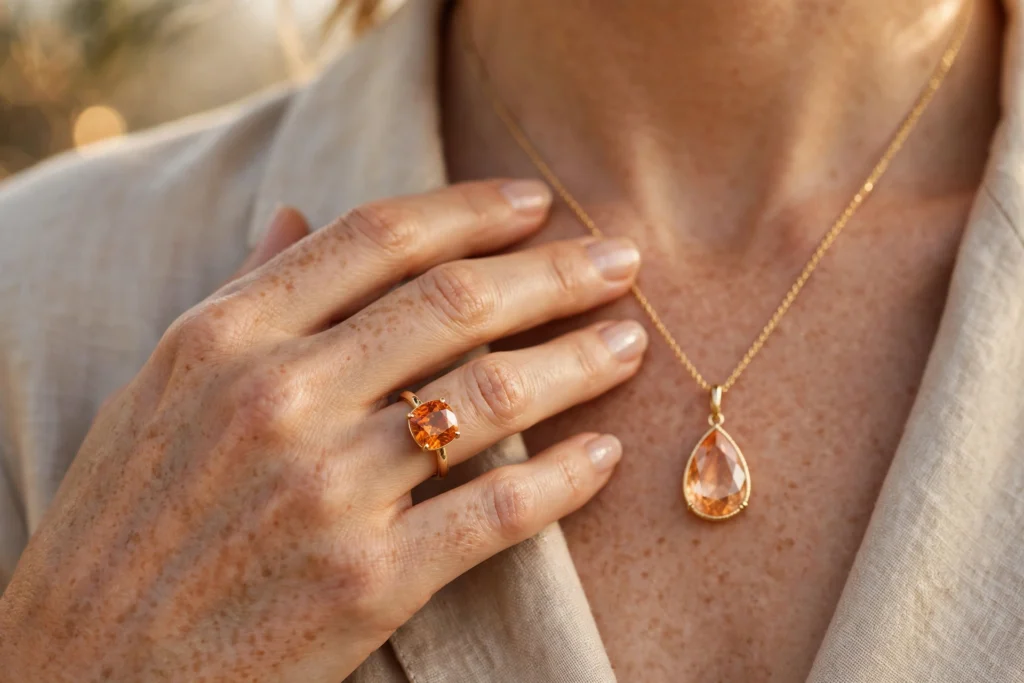
Best Orange Gemstone for Your Jewelry
Start with how the piece will be worn. Rings hit hard surfaces, bracelets rub against watches, cuffs, and tabletops, and earrings and pendants face the least impact — so softer stones belong in earrings and pendants first.
| Jewelry Type | Best Choices | Good With Care | Avoid / Occasional Only |
|---|---|---|---|
| Everyday ring / engagement ring | Orange sapphire, orange spinel, orange diamond | Spessartine garnet, citrine, tourmaline, topaz (protective setting) | Fire opal, moonstone, amber, coral, calcite |
| Bracelet (beads or set stones) | Carnelian, orange agate, orange jasper, sardonyx, citrine | Sunstone, peach moonstone | Amber, coral, orange calcite |
| Necklace / pendant | Almost all 20 stones work | Fire opal, amber, coral (keep away from perfume) | — (pendants are the safest setting) |
| Earrings | Almost all 20 stones work | Amber and coral are light and comfortable | — |
Short answer: For a ring you will wear every day, choose orange sapphire first, orange spinel second. For a bracelet, choose carnelian, agate, jasper, or sardonyx beads. For earrings and pendants, you can safely choose almost any orange stone in this guide, including soft amber, coral, and fire opal.
How to Choose & Buy an Orange Gemstone
Follow these steps in order — they will prevent almost every common buying mistake.
- Choose the shade first. Peach, mandarin, red-orange, honey, or earthy brown. Shade decides which stones are even candidates.
- Match the stone to the jewelry. Check the table above. A pendant can use a soft stone; a daily ring cannot.
- Set a budget tier. Affordable ($): citrine, carnelian, agate, jasper, sardonyx, calcite, tangerine quartz. Moderate ($$): hessonite, zircon, tourmaline, sunstone, spinel. High ($$$–$$$$): orange sapphire, mandarin garnet, imperial topaz, fire opal (fine), orange diamond.
- Ask about treatment — in writing. Heat, dye, diffusion, coating, filling, stabilization, and lab-grown origin all affect value. Treatment is not automatically bad; undisclosed treatment is the problem.
- Know the red flags. A “padparadscha” with no lab report, a vivid orange sapphire priced like citrine, amber that feels cold and heavy like glass or plastic-priced as fine Baltic material, and any seller who will not name the exact material.
- Ask for a report when the price justifies it. For orange sapphire, orange diamond, imperial topaz, and any stone sold as untreated or padparadscha, an independent gemological report (for example, from GIA) is worth more than any sales description.
- Inspect construction, not just the stone. For bead jewelry, check drill holes for chips, cord and knots for quality, and edges for stones set too close to a weak point. For set stones, check that prongs or bezels actually protect the edges.
How to Tell If an Orange Gemstone Is Real
There is no reliable home test that proves a gemstone is real. Price that seems too good for the claimed stone, perfectly uniform color in “natural” beads, bubbles inside the material (a sign of glass), and a seller who uses only vague names like “orange crystal” are warning signs. A simple scratch or temperature test can damage a real stone and proves very little. For anything beyond inexpensive fashion jewelry, the reliable route is a gemologist or a laboratory report.
Orange Gemstone vs Orange Crystal & Padparadscha vs Orange Sapphire
What Is the Difference Between an Orange Gemstone and an Orange Crystal?
A gemstone is a material selected, cut, or polished for jewelry or ornament. A crystal is a solid with an ordered internal atomic structure. Many orange gemstones are crystals (sapphire, garnet, quartz), but the words are not interchangeable: amber is a gemstone but not a crystal, and plenty of orange mineral crystals are too fragile or unsuitable for jewelry. When a seller says “orange crystal,” ask for the actual material name.
Padparadscha vs Orange Sapphire — What Is the Difference?
Padparadscha is not a separate mineral. It is a prized color category within sapphire: a delicate blend of pink and orange — often described as the color of a lotus blossom or a sunset — with light-to-medium tone and low-to-moderate saturation. A strongly saturated, purely orange sapphire is an orange sapphire, not a padparadscha, even if a seller labels it that way. Because the padparadscha label raises the price significantly and labs apply the term by opinion within a defined hue range, only buy a “padparadscha” with an independent lab report that actually uses the word.
How to Care for Orange Gemstone Jewelry
General rule: Clean most orange gemstone jewelry with a soft, slightly damp cloth and dry it thoroughly. Lukewarm water with mild soap is safe for many stones — but only when the stone, its treatment, the setting, the cord, and the metal can all tolerate it. Do not assume ultrasonic or steam cleaning is safe.
| Care Group | Stones | How to Clean | Keep Away From |
|---|---|---|---|
| Hard, stable | Orange sapphire, spinel, citrine, carnelian, agate, jasper, sardonyx | Warm water, mild soap, soft brush | Hard knocks; storing loose with diamonds |
| Moderate / heat- or cleavage-sensitive | Garnet, tourmaline, zircon, topaz, sunstone, moonstone, tangerine quartz | Soft cloth, lukewarm water only; no ultrasonic if included or coated | Sharp impact, sudden temperature change, ultrasonic cleaners |
| Soft / delicate | Fire opal, amber, coral, orange calcite | Soft damp cloth only; wipe coral and amber after wear | Heat, drying, perfume, hairspray, solvents, acids, swimming and showering |
Store pieces separately so harder gems do not scratch softer ones. Remove bracelets and rings before swimming, showering, workouts, and applying perfume or sunscreen. Keep amber away from solvents and heat, and protect opal from temperature extremes and very dry conditions.
FAQs
What gemstones are naturally orange?
Sapphire, spessartine and hessonite garnet, fire opal, zircon, topaz, carnelian, sunstone, citrine, tourmaline, spinel, diamond, moonstone, agate, jasper, sardonyx, and tangerine quartz can all occur naturally in orange shades. Amber and coral can also be naturally orange, but they are organic gem materials rather than minerals. Orange calcite is also natural. Treatments are common in the market, so “naturally orange” does not always mean “untreated.”
What is the most common orange gemstone?
Carnelian is the most common orange gemstone. It is an affordable, durable variety of chalcedony used in beads, cabochons, and carvings worldwide. Citrine is the most common transparent, faceted orange gemstone.
What is the rarest orange gemstone?
A natural diamond with a pure, unmodified orange hue is among the rarest. Fine padparadscha sapphire, vivid untreated orange sapphire, and top-quality imperial topaz are also exceptionally rare, depending on how strictly the color is defined.
Which orange gemstone is the most valuable?
Fine natural fancy-orange diamond generally occupies the highest-value category, especially with pure, strongly saturated color and documented natural origin. After that come fine padparadscha and vivid orange sapphire, mandarin garnet, and true imperial topaz. Individual prices always depend on the specific stone.
What orange gemstone is best for everyday wear?
Orange sapphire is the strongest all-round choice for a ring worn every day (Mohs 9, good stability), with orange spinel (Mohs 8, usually untreated, no cleavage) a close second. For bead bracelets, carnelian, agate, jasper, and sardonyx are practical everyday options. No stone is damage-proof — setting and care still matter.
What is the November birthstone in orange?
Both of November’s birthstones come in orange: topaz — most traditionally in its golden-to-imperial-orange form — and citrine, in golden to reddish-orange shades. Imperial topaz is the premium choice; citrine is the affordable one.
Is citrine an orange gemstone?
Yes. Citrine is a transparent quartz variety whose color ranges from pale yellow to deep brownish or reddish orange. Many people picture it as yellow, but Madeira-shade citrine sits clearly in the orange range. Most citrine sold today is heat-treated amethyst, which should be disclosed even though the treatment is widely accepted.
Is carnelian a gemstone?
Yes. Carnelian is a gem variety of chalcedony, a microcrystalline form of quartz. It is usually translucent, ranges from orange through red-orange to reddish brown, has a hardness of about 6.5 to 7, and is widely used in bracelets, pendants, and rings.
Is orange sapphire the same as padparadscha?
No. Padparadscha is a specific pink-orange color category within sapphire, defined by a delicate balance of pink and orange. A vivid, purely orange sapphire is not a padparadscha. Because the name adds a premium, require a lab report that applies the term before paying for it.
Are orange gemstones expensive?
They range from a few dollars to prices per carat that rival fine diamonds. Bead stones like carnelian, agate, and jasper and faceted citrine are inexpensive. Orange sapphire, mandarin garnet, imperial topaz, and especially natural orange diamond are expensive. Shade, size, clarity, origin, and treatment decide the price of any individual stone — not the name alone.
How can I tell if my orange gemstone is real?
You usually cannot prove it at home. Warning signs of imitation include internal bubbles (glass), suspiciously perfect color at a very low price, and sellers who will not name the material or disclose treatments. For valuable stones, use a gemologist or an independent laboratory report instead of home tests, which can damage a genuine stone.
What is the difference between an orange gemstone and an orange crystal?
A gemstone is a material worked for jewelry or ornament; a crystal is a solid with an ordered atomic structure. Many orange gemstones are crystals, but amber is a gemstone and not a crystal, and some orange crystals are too fragile for jewelry. Always ask for the specific material name behind the word “crystal.”
Conclusion: Choosing an Orange Stone You Will Actually Wear
The best orange gemstone is the one whose shade, durability, construction, and care fit your real routine. Choose orange sapphire or spinel for a ring you never take off, carnelian or jasper beads for a bracelet you wear daily, citrine for a large faceted stone on a budget, and fire opal, amber, or coral when you want maximum color in a piece you wear with care. Decide the shade, match it to the jewelry, ask about treatment in writing — and the stone you choose will be one you actually wear, not one you keep in a box.
For more guides on fashion, style, and everyday topics, explore the latest posts on Magazine Diary.